
Student Changemakers in Action: Quality Homes for Humankind
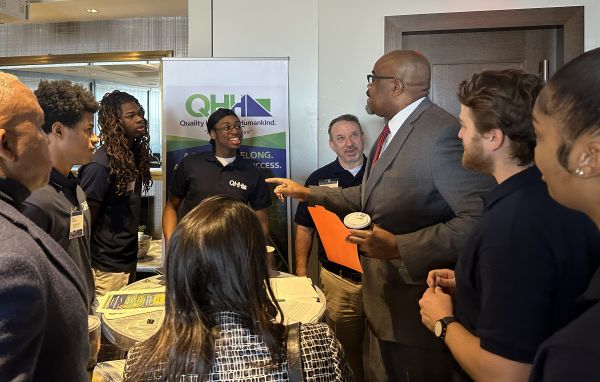
In spring 2025, Brian Hodge Molina and a group of his fellow TechBoston Academy classmates found themselves at a crossroads. Using the Rennie Center’s Student Changemakers curriculum—which guides young people to investigate local challenges—they had been working on generating ideas for dealing with the issue of gun violence. This was a deeply personal topic for the team: a few years earlier, a student and teacher from TechBoston had been wounded in a shooting just outside the school building. As Brian puts it, “We thought that it would be an amazing idea to provide a solution for an issue that deeply affects our community.”
The team presented their ideas at the 2025 Aspen Challenge, a competition hosted by the Aspen Institute and designed to elevate youth-led solutions to pressing social issues. But despite pouring their heart and soul into their presentation, they were not chosen as one of the winning teams.
Although the students were heartbroken, they were still determined to make an impact. Rather than simply pressing ahead with their original idea, they stepped back. They dug more deeply into the research and data, looking beyond gun violence itself to better understand the conditions that leave young people vulnerable to it. That process began to point them toward a different kind of solution—one focused not only on preventing violence, but on creating the stability and opportunity young people need to build a path forward.
That process reflects the idea at the heart of Student Changemakers. For years, the Rennie Center has worked with educators and community leaders to use research and data to understand challenges, identify root causes, and make informed decisions about how to improve schools and communities. The Changemakers curriculum puts young people in the driver’s seat of that same process, giving them the tools and ownership to investigate the issues affecting their communities and lead the search for solutions.
As their thinking evolved, so did their ambitions for the project. The students wanted to build something that could last beyond a class, a competition, or their own time at TechBoston. With their research pointing them toward a more comprehensive solution that would require partnerships, funding, and sustained work, they began to see the need for a more formal structure. According to Dr. Bruce Pontbriand, the TechBoston teacher overseeing the Changemakers process, establishing a nonprofit offered a way to give the work that long-term grounding. Students did not want what they had built to be labeled merely a “passion project.” Having engaged in extensive research and analysis to understand the root causes of gun violence, the youth leaders officially launched a 501(c)(3) organization called Quality Homes for Humankind (QHH) in summer 2025.
QHH is designed to prevent young people from falling into the “Lost Middle”—that is, those aged 18-26 who are in a transitional period without a clear path forward. (The Rennie Center has produced several research reports in the past on how to support college and career pathways for this group, which we refer to as “opportunity youth.”) QHH addresses a crucial gap in the nonprofit ecosystem: workforce development organizations rarely address housing needs, while funding designed to support stable housing does not support connections with jobs—at least, not those that build generational wealth and lead to upward mobility.
Rather than addressing each challenge separately, QHH seeks to take a holistic approach, providing a safe, welcoming home environment for individuals participating in workforce programming in order to set participants on a path toward a stable income and permanent housing. Their North Star goal is to house around 20 associates for up to 18 months as those individuals pursue paid apprenticeships or other career training opportunities.
Already, QHH leaders have established partnerships with two local workforce partners: Action for Equity and New England Culinary Arts Training (NECAT). Under the agreement with Action for Equity, QHH will offer two types of programming. High school students interested in careers in HVAC and refrigeration will be able to participate in an introductory opportunity that connects them with industry-recognized credentials. Meanwhile, a six-month training for recent graduates will allow participants to earn all the certifications needed to get a job immediately upon completion. A separate program being planned and led in partnership with NECAT will introduce participants to the culinary industry, giving them a taste of what it means to work in restaurants or catering.
While the workforce elements of QHH’s programming are well underway, the leadership team is currently exploring numerous housing options, looking into potential routes such as adaptive reuse and urban land conservancy. Once they’ve identified the most promising options, they plan to seek funding that would allow them to acquire and manage a property—ideally within the next year.
QHH offers a compelling vision of how multiple systems (housing, education, and workforce development) can work together in service of a shared goal. It also illustrates the power of community to rally behind solutions that are meaningful for local residents. One of the most powerful elements of QHH, in the words of TechBoston educator Dr. Pontbriand, is how “the people that are designing the solutions are the people being impacted by the problem.”
That process reflects the idea at the heart of Youth Participatory Action Research (YPAR), the approach that underpins the Rennie Center’s Student Changemakers curriculum. An important part of the YPAR approach is connection with peers, community members, and audiences who can help turn students’ ideas into action. To help build those connections, TechBoston students (along with students from other Changemakers sites) attended Rennie’s Condition of Education release event in January 2026 and met with then-Secretary of Education Patrick Tutwiler. This event served as an important catalyst for QHH. The conversations they had during the event led to a grant from The Boston Foundation, which has sparked additional funding opportunities and conversations with local foundations.
In a full-circle moment, the QHH team also entered the Aspen Challenge contest again this year—and won. They have since had the opportunity to showcase their idea on a national scale: QHH leaders presented to the Bezos Family Foundation about their work, and the organization will be spotlighted in the Aspen Institute’s 2026 Impact Report. The team has also met with politicians and youth leaders from cities across the country interested in understanding—and potentially adopting—their model, including the mayor of Denver and young people from Detroit and Los Angeles.
Closer to home, however, the team is still working to be seen as a serious player in the nonprofit environment. Micael Gelin, a rising senior at TechBoston Academy and QHH’s Youth Leader for Workforce Development and Strategic Partnerships, described the challenge of “building credibility…One thing that we found very hard is reaching out to people who could help us with certain things like giving us grants, or connecting us to people or organizations in their networks. We’re unable to get those connections because they see us as a youth organization.”
For now, QHH staff will focus on refining their business plan, expanding their programming, and meeting with local organizations and officials—while also continuing to balance their work on QHH with jobs, school, and home life, as they have done since the project’s inception. All are deeply committed to QHH’s success, but the impact of their work extends beyond the organization itself. Along the way, these young leaders are developing skills that will serve them well beyond their time at TechBoston as they learn to understand the challenges facing their communities, use research and evidence to develop solutions, build partnerships, and take informed action to create change. These young leaders have already accomplished so much, but as they connect young people with career pathways and work toward the goals they have set for themselves and their organization, it’s clear that they’re just getting started.
As Dr. Pontbriand puts it, “Here’s the community coming together trying to answer and solve its own problems….It’s pretty amazing to see—and it all started with a little YPAR project.”
If you are interested in partnering to bring Student Changemakers to your school or community, contact Rennie Center Senior Associates Amanda Chung (achung@renniecenter.org) or Chau Ngo (cngo@renniecenter.org).